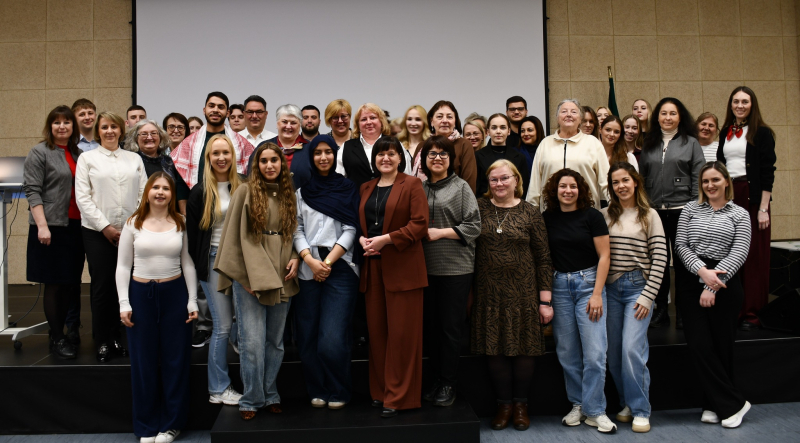
From March 23–27, 2026, a variety of events took place during the international Erasmus+ week, including lectures by visiting professors, presentations by partner institutions, a scientific-practical conference, and a blended intensive program for students. Guests from Poland, Latvia, the Czech Republic, Spain, Jordan, Turkey, Albania, and France had the opportunity not only to participate in academic activities but also to get acquainted with Lithuanian traditions and culture.
At the international scientific-practical conference “Aspects of Sustainable Development: Theory and Practice,” significant attention was given to promoting sustainable development and applying its principles in practice. The role of science and education in building a more sustainable society was discussed, and best practices were shared. The event was opened and the participants of the plenary session were welcomed by Dr. Vaida Bartkutė-Norkūnienė, Dean of the Faculty of Business and Technologies.
During the plenary session, it became evident that issues of sustainable development are closely related to everyday decisions—from financial accessibility in regions to the influence of education and science on shaping a responsible society. Dr. Tom Hashimoto emphasized the importance of cooperative banks for regions, highlighting their role in providing financial services to small businesses and local communities, as well as contributing to economic stability. Dr. Raimondas Grubliauskas highlighted the significance of universities as leaders of change, emphasizing the interaction between studies, research, and innovation, as well as the integration of sustainability principles into all activities. Dr. Estela Daukšienė stressed the importance of education, especially in training teachers who shape future generations’ attitudes toward sustainability. The plenary session was moderated by Dr. Rūta Meištė.
Conference sessions addressed topics such as income inequality in Europe, the sustainability of artificial intelligence, fostering employee creativity, the application of circular economy principles, air pollution research, radiological measurements in the environment of the Ignalina Nuclear Power Plant, sustainability in the tourism sector, and the development of digital skills. Considerable attention was also given to innovation, human well-being, mental health, digital hygiene, and the application of technologies across various fields.
Students also actively participated in the conference, and their presentations stood out for their relevance and diversity. They explored topics ranging from the impact of noise on the environment and health to the use of artificial intelligence in digital content creation, responsible consumption, ethics in digital marketing, business decision-making, educational challenges, social values, and technological innovations. Issues such as air and water quality, CO₂ capture, biodiversity, robotization, and food waste were also analyzed. Student presentations revealed their creativity, critical thinking, and ability to apply theoretical knowledge to solving real-world problems.
An important part of the Erasmus+ international week was the blended intensive program for students titled “From Evidence to Action: Simulation-Based and Patient-Centered Decision-Making in Interdisciplinary Health and Social Care Teams.”
Participants of the international week were also offered excursions to Utena and Vilnius. Guests visited the Old Town of the capital and learned interesting facts about the city and Lithuania. At the Utena Regional Museum, they experienced the virtual program “Paths of Angels” and tried a traditional Lithuanian activity—Easter egg decorating. They also attended an evening event the Utena Cultural Centre together with the song and dance ensemble “Vieversa.”
This international week brought together students, lecturers, and partners from various countries, promoted intercultural cooperation and the sharing of experiences, and contributed to the development of a more sustainable and responsible society.